 20% OFF Start Challenge Code:




What is a prop firm? A prop firm (proprietary trading firm) is a financial institution that allocates corporate capital to skilled retail traders, allowing them to trade the financial markets without risking their own money. Traders must first pass a rigorous evaluation phase to demonstrate consistent profitability and strict risk management. Upon successful completion, they receive a funded account where they retain a significant majority of the generated profits—typically ranging from 70% to 90%—while the company absorbs 100% of the capital losses. This mutually beneficial model democratizes access to institutional-level liquidity.

Navigating the proprietary trading landscape requires a deep understanding of structural frameworks, evaluation metrics, and industry shifts. Below is the table of contents detailing the core components of modern funded trading.
The Mechanics of Proprietary Trading
Proprietary trading operates on a remarkably straightforward premise: matching capital with talent. Historically, proprietary trading desks were exclusive environments located on Wall Street, requiring elite university degrees and intensive inside connections. Today, the democratization of financial technology has shifted this dynamic entirely online. Remote funded trader programs allow individuals from any geographical location to prove their market acumen through simulated environments before managing live capital.
The operational framework relies heavily on data aggregation and risk mitigation. When an individual executes a trade, the system monitors their performance against predefined risk parameters. If the trader consistently generates positive returns while adhering to loss limits, the company utilizes copy-trading algorithms to mirror those successful trades in their master corporate accounts. The trader operates in a highly controlled ecosystem, ensuring the company’s baseline capital remains protected from erratic market behavior.
Furthermore, the modern proprietary ecosystem utilizes advanced B-book and A-book methodologies. While novice participants trade in simulated conditions to generate challenge fees, proven professionals are transitioned to live liquidity pools. This hybrid approach ensures sustainable business operations for the company while providing unlimited upside for the talented market analyst.
Decoding Trader Evaluations and Challenges
Securing institutional funding is never an arbitrary process. Companies implement structured evaluations, often referred to as “challenges,” to filter out gamblers and identify statistical probability thinkers. These assessments traditionally consist of two distinct phases. Phase one demands aggressive profit targets—usually around 8% to 10%—within strict drawdown constraints. Phase two acts as a verification stage, requiring a lower profit target to confirm that the initial success was not the result of sheer luck.
The parameters within these assessments are designed to test psychological resilience as much as technical strategy. Competitors must navigate daily loss limits and maximum overall drawdowns. Violating any of these rigid parameters results in immediate account termination. The stringency of these rules ensures that only the top tier of participants ever touches corporate funds.
In 2026, the industry standard has evolved to heavily favor the trader. Archaic constraints, such as mandatory time limits to reach profit targets, have been largely eradicated by top-tier institutions. By removing arbitrary deadlines, candidates can execute swing trading strategies and wait for high-probability setups without the anxiety of a ticking clock.
Why Do Financial Institutions Fund Retail Traders?
Who funds traders, and what is their underlying motive? The answer lies in the concept of crowdsourced alpha. Financial markets are infinitely complex, and no single algorithmic model or centralized trading desk can capture every profitable opportunity across all global assets. By distributing capital across thousands of independent analysts, the institution diversifies its market exposure.
This decentralized approach to talent acquisition drastically reduces the firm’s overhead. Instead of paying hefty salaries, bonuses, and maintaining expensive physical office spaces, the institution operates on a strict performance-based model. They only pay for success. If an individual fails to generate yield, the company owes them nothing.
Additionally, the data generated by thousands of participants is a highly lucrative asset. Institutions analyze the behavioral data of failed accounts to understand retail market sentiment, often using this information to hedge their own internal positions. The ecosystem transforms individual trading metrics into actionable corporate intelligence.
Capital Allocation and Profit Splitting Models
The financial mechanics of funded accounts are structured to incentivize massive wealth generation for both parties. Upon passing the required assessments, the participant signs an independent contractor agreement. They do not deposit personal funds into the live account; the balance is entirely corporate.
Profit distributions are processed on a predefined schedule, which has aggressively accelerated in recent years. While legacy systems required monthly waits for fiat bank transfers, modern platforms execute payouts bi-weekly or instantly via digital assets. The split ratio heavily favors the individual who executed the work.
| Metric | Retail Trading Account | Proprietary Funded Account |
|---|---|---|
| Capital Source | Personal Savings | Corporate Treasury |
| Risk Assumption | 100% Trader | 100% Firm |
| Scaling Potential | Slow (Compound Growth) | Rapid (Account Scaling Plans) |
| Profit Retention | 100% | 70% – 90% |
The 2026 Shift: Decentralization and Crypto Funding
The traditional foreign exchange and equities markets suffer from weekend closures, heavy regulatory fragmentation, and slow fiat settlement times. The most significant evolution in 2026 is the mass migration toward cryptocurrency markets. Digital assets trade 24/7, providing uninterrupted opportunities for market participants worldwide.
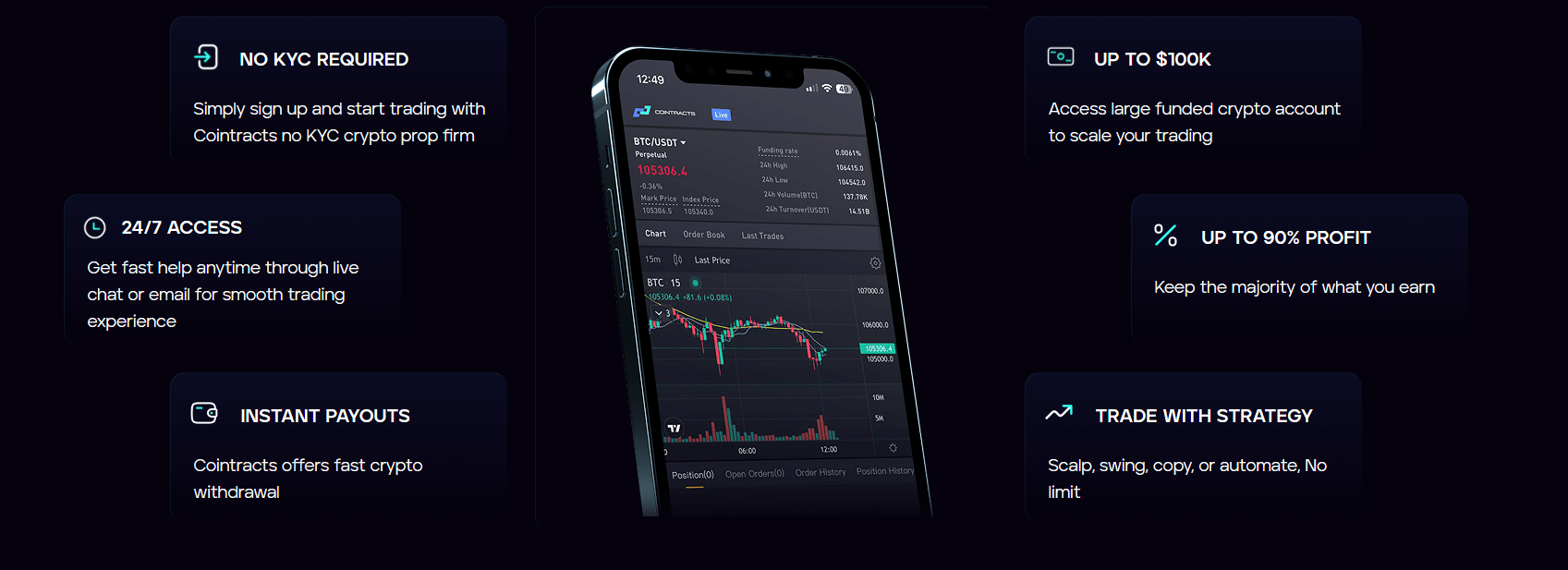
For those targeting digital assets, a crypto prop firm like Cointracts represents the apex of modern infrastructure. Cointracts eliminates the friction of legacy finance by offering specialized crypto futures evaluations. Participants benefit from zero time limits, ensuring they can trade digital assets at their own pace based on true market structures rather than forced deadlines.
Furthermore, instant crypto payouts have become the golden standard. Cointracts ensures that once a trader requests a withdrawal of their profit split, the transaction is verified and settled on the blockchain rapidly. This eliminates the archaic waiting periods associated with international wire transfers, proving that blockchain integration is mandatory for tier-one funding institutions.
Understanding Drawdown Rules and Risk Parameters
The bedrock of institutional capital protection is the drawdown rule. A maximum drawdown represents the absolute threshold an account balance can drop before the account is liquidated. Understanding the difference between static and trailing drawdowns is critical for survival.
A static drawdown remains fixed at the initial starting balance. For example, a $100,000 account with a 10% static drawdown means the account cannot drop below $90,000, regardless of how much profit is accumulated. Conversely, a trailing drawdown follows the high-water mark of the account. If the balance reaches $105,000, the drawdown threshold moves up accordingly, strictly protecting open profits.
Daily loss limits further complicate the risk landscape. This parameter restricts the amount of capital that can be lost within a single 24-hour trading cycle, typically resetting at midnight server time. Mastering these dual constraints requires participants to meticulously calculate their position sizing and leverage before executing any market order.
Core Advantages of Trading with Corporate Capital
Leveraging external capital profoundly alters the mathematical reality of trading. A highly skilled analyst with only $1,000 in personal savings might earn a phenomenal 10% return in a month, yielding a mere $100. The identical skill set applied to a $200,000 funded account yields $20,000. Institutional backing bridges the gap between raw talent and actual financial freedom.
Beyond the mathematics, the psychological barrier of risking personal savings is entirely removed. The emotional stress of losing rent money or retirement funds often causes retail investors to panic sell or abandon logical strategies. Trading corporate funds cultivates a detached, clinical mindset necessary for flawless execution.
Moreover, top-tier platforms implement aggressive scaling plans. If a participant demonstrates consistent profitability over several payout cycles, the institution will organically increase their capital ceiling. An initial $50,000 allocation can rapidly scale into millions of dollars in purchasing power without the individual ever taking on additional personal financial liability.
Identifying Transparent Funding Programs versus Scams
The explosion of the remote funding industry has inevitably attracted malicious actors. Identifying a legitimate institution requires strict due diligence. Transparent programs clearly publish their evaluation rules, profit split ratios, and payout proofs. They do not hide complex constraints within convoluted terms of service.
Red flags include sudden changes in spread, artificial slippage, and proprietary trading platforms that suffer from intentional latency during high-impact news events. Malicious companies rely on generating revenue strictly from evaluation failure fees; therefore, they design environments meant to trigger rule violations artificially.
Legitimate entities operate with reputable liquidity providers and provide raw spreads. They want their professionals to succeed because copy-trading profitable data is far more lucrative than collecting nominal challenge fees. Always verify the company’s payout history on third-party auditing sites before initiating an assessment.
Structuring a Strategy for Proprietary Capital
Strategies that work for small retail accounts frequently fail in institutional environments. Retail participants often utilize aggressive averaging down, martingale systems, or massive leverage to flip small balances. These behaviors guarantee immediate failure in a structured evaluation due to strict drawdown breaches.
A compliant strategy must prioritize high win rates or exceptional risk-to-reward ratios while keeping maximum exposure minimal. Risking no more than 0.5% to 1% of the total account balance per trade ensures that a string of inevitable losses will not trigger the daily loss limit.
Algorithmic traders must also ensure their Expert Advisors (EAs) comply with the firm’s specific regulations. Some institutions prohibit high-frequency trading (HFT) or latency arbitrage. Adapting a mechanical system to respect the specific boundaries of the funding provider is the first step toward long-term monetization.
The Psychology of the Funded Trader
Passing an evaluation is a technical achievement; maintaining the funded account is a purely psychological battle. The transition from a simulated challenge environment to a live, profit-generating status often induces a phenomenon known as “funded paralysis.” Analysts become terrified of violating rules and losing their newly acquired capital status, leading to hesitation and missed setups.
To combat this, elite professionals treat the live account identically to the evaluation phase. They do not alter their position sizing, nor do they adjust their specific setup criteria. Consistency is the only metric that matters.
Another psychological trap is the desire for immediate massive payouts. Instead of aiming for a 10% gain in the first week, seasoned professionals aim for a steady 2% to 3% monthly yield. Small, consistent withdrawals build an audited track record, ensuring mental stability and long-term partnership with the institution.
Preparing for a Long-Term Funded Career
Where to get trading capital is no longer the primary hurdle for the modern market analyst; the challenge is sustained performance. Building a career requires treating the funded account as a legitimate business rather than a lottery ticket. This involves maintaining meticulous journals, tracking statistical performance, and continuously refining edge.
Diversification within the proprietary space is also highly recommended. Managing multiple funded accounts across different reputable firms protects the individual from sudden regulatory shifts or individual company insolvencies. Utilizing trade copiers allows an analyst to execute a single strategy simultaneously across various accounts, multiplying the potential profit splits.
As the landscape moves firmly into 2026, those who adapt to 24/7 digital asset markets, leverage transparent evaluation models, and adhere to strict mathematical risk parameters will secure their position at the forefront of the decentralized finance revolution.
