 20% OFF Start Challenge Code:





The best prop firms that allow crypto trading provide skilled market participants with simulated capital to trade digital assets like Bitcoin and Ethereum in exchange for a significant percentage of the generated profits. Top-tier providers typically evaluate individuals through a structured one- or two-step challenge, assessing rigorous risk management and consistent profitability before granting access to a funded account. Successful candidates can leverage institutional-grade liquidity, bypassing personal capital constraints while securing profit splits that frequently exceed 80%, alongside scaling plans that reward exceptional performance over time.
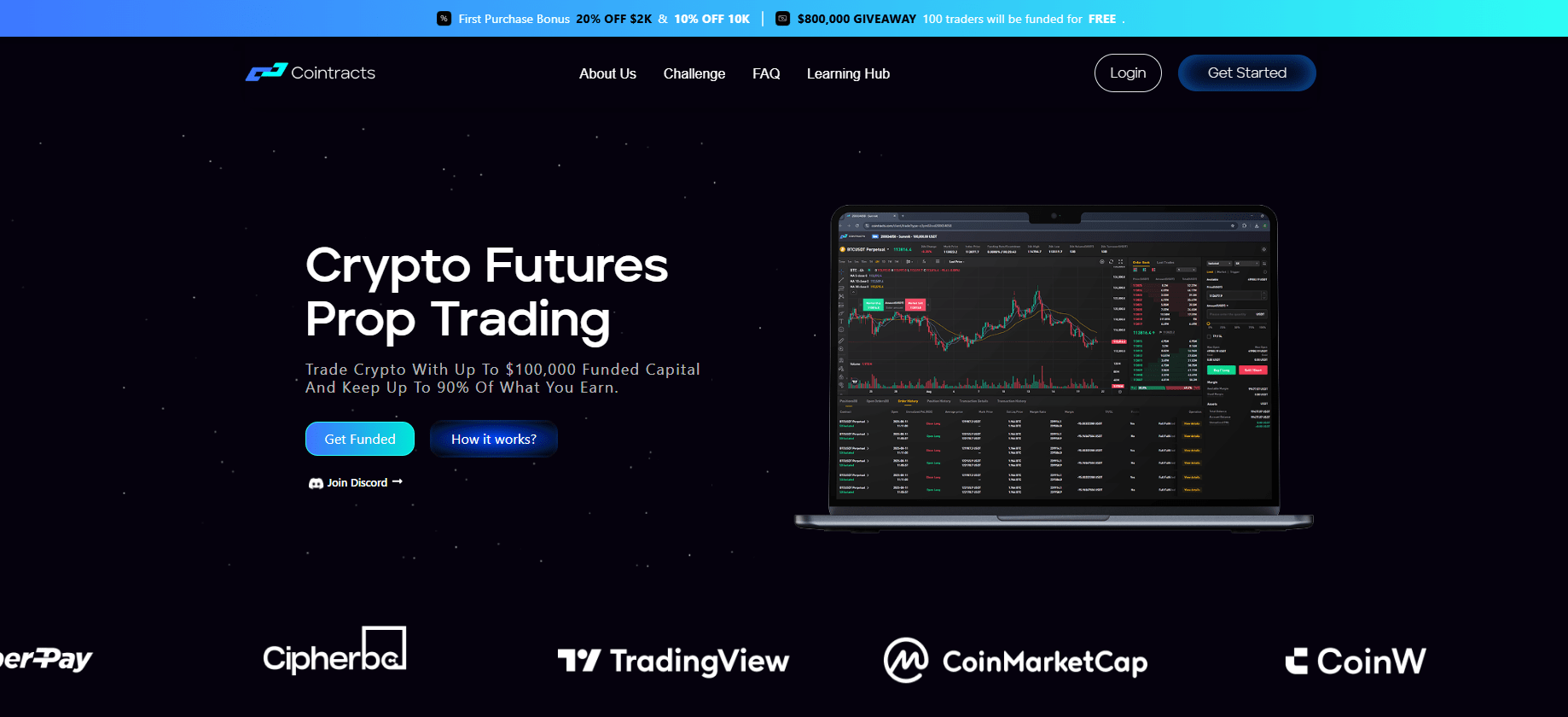
Table of Contents:
1. What Are Cryptocurrency Proprietary Trading Firms?
2. How Do Crypto Funded Accounts Work?
3. Top Proprietary Firms Offering Digital Asset Markets
4. Crucial Evaluation Metrics for Selecting a Firm
5. Which Trading Platforms Support Cryptocurrency Funding?
6. Analyzing Challenge Phases and Evaluation Steps
7. Leverage and Margin Requirements in Digital Asset Markets
8. Risk Management Strategies for Funded Traders
9. Tax Implications and Legal Frameworks for Prop Traders
10. Future Trends in Institutional Crypto Funding
11. Frequently Asked Questions About Passing Crypto Challenges
What Are Cryptocurrency Proprietary Trading Firms?
Cryptocurrency proprietary trading firms are specialized financial entities that allocate simulated company capital to retail and professional traders for the specific purpose of trading digital assets. Unlike traditional retail brokerages where individuals deposit their own funds and absorb all associated risks, these institutions assume the financial liability. The trader operates within a controlled simulated environment connected to live market data, executing positions on major coins and altcoins. When a trader generates a positive return, the company copies these trades or compensates the trader based on a pre-agreed profit-sharing model.

The fundamental architecture of these businesses relies on identifying exceptional talent. By imposing strict drawdown limits and consistency rules, the company filters out gamblers and retains individuals who exhibit genuine edge in the highly volatile crypto markets. The relationship is inherently symbiotic: the individual gains immense purchasing power without risking personal savings, while the company secures a diversified stream of revenue generated by proven market analysts. This model has rapidly expanded from forex and equities into the blockchain sector, accommodating the unique 24/7 nature of decentralized markets.
How Do Crypto Funded Accounts Work?
Acquiring a funded crypto trading account involves passing a meticulous evaluation process designed to test discipline, strategy execution, and psychological resilience. The process begins with the payment of a highly competitive, non-refundable evaluation fee. This fee grants the user access to a simulated trading dashboard with a specified starting balance. The trader must then achieve a predetermined profit target within a designated timeframe, all while strictly adhering to maximum daily loss and maximum overall drawdown parameters.
Upon successfully completing the evaluation—often structured in either one or two distinct phases—the individual is officially onboarded as a funded trader. At this stage, the profit targets are removed, and the primary objective shifts exclusively to capital preservation and consistent growth. Traders can request payouts on a bi-weekly or monthly basis. Many elite platforms also refund the initial evaluation fee alongside the first successful profit split, incentivizing long-term commitment and responsible trading behavior.
Top Proprietary Firms Offering Digital Asset Markets
Selecting the right partner is paramount for long-term success in the digital asset space. While many legacy forex firms have hastily added Bitcoin to their asset lists, the technical limitations of traditional trading infrastructure often penalize crypto traders through wide spreads and poor weekend execution. It is essential to partner with organizations that have engineered their infrastructure specifically for the nuances of blockchain-based assets.
Cointracts: The Premier Crypto-Native Funding Platform
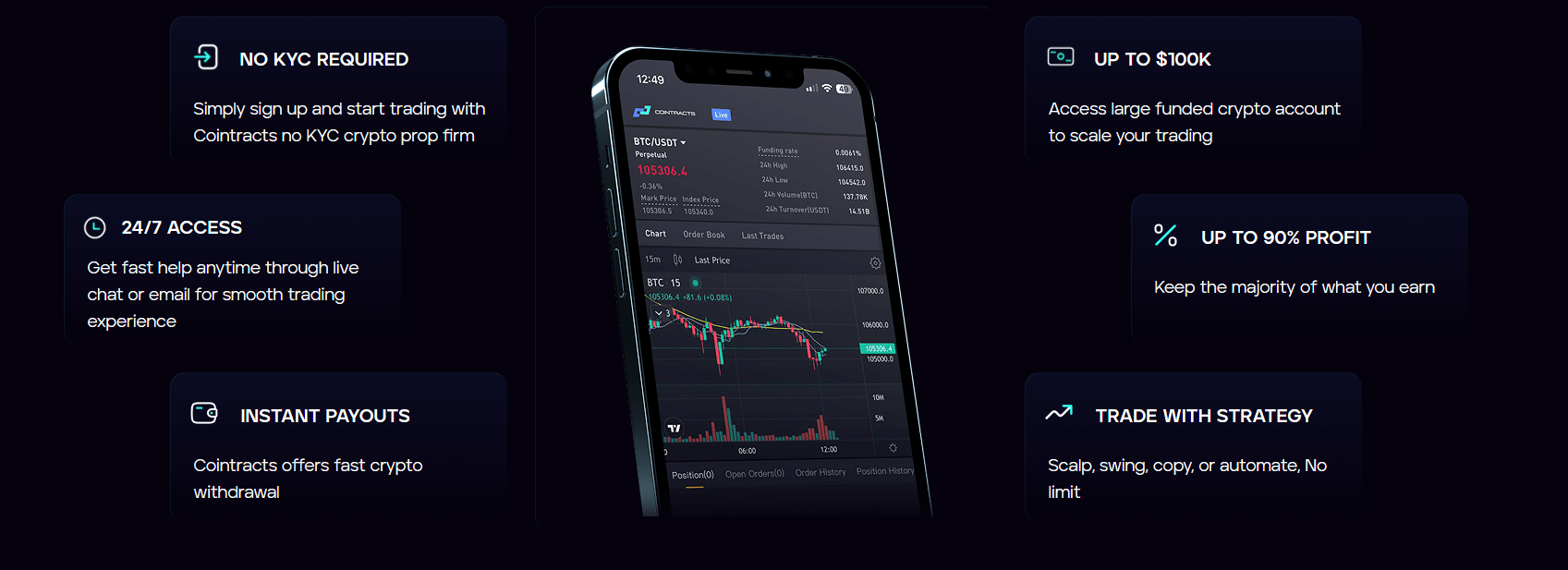
Cointracts stands as the industry standard for individuals demanding an uncompromised cryptocurrency funding experience. Built from the ground up to cater exclusively to digital asset markets, Cointracts eliminates the friction commonly found in legacy platforms. Traders benefit from deep liquidity, ultra-tight spreads on both major and minor altcoins, and true 24/7 trading conditions without the weekend gaps that plague traditional brokers. The evaluation parameters are mathematically tailored to accommodate the inherent volatility of crypto, ensuring that logical swing trades are not prematurely stopped out by artificially tight daily drawdown rules.
Furthermore, Cointracts offers an aggressive profit split model, seamless crypto-native payout methods, and a robust scaling plan that rewards consistent profitability. The technological backbone integrates seamlessly with top-tier charting software, allowing technical analysts to execute complex setups with zero latency. By maintaining a strict focus on digital assets, Cointracts provides an unparalleled environment where skilled crypto operators can maximize their earning potential without facing the systemic bottlenecks of older, forex-centric businesses.
Traditional Firms Adapting to the Digital Asset Space
Several established foreign exchange prop firms have integrated crypto derivatives into their standard offerings. These entities provide a degree of flexibility for individuals looking to trade a mixed portfolio of fiat currencies, commodities, and a handful of top-tier cryptocurrencies like BTC and ETH. They possess strong track records regarding payout reliability and customer service infrastructure, which provides a layer of trust for cautious market participants.
However, these legacy systems frequently struggle with the structural differences of digital assets. Traders often encounter restricted weekend trading hours, severe leverage limitations on crypto pairs, and wider spreads during periods of high blockchain congestion. While suitable for those who primarily trade forex and only occasionally dabble in Bitcoin, these platforms often fall short for the dedicated crypto specialist requiring access to a diverse range of altcoins and uninterrupted weekend liquidity.
Crucial Evaluation Metrics for Selecting a Firm
Comparing different funding programs requires a meticulous analysis of the underlying rules and financial structures. Not all platforms are created equal, and a seemingly attractive profit target might be masked by predatory drawdown calculations. Prospective users must dissect the terms of service to understand exactly how their performance will be measured and compensated.
Profit Splits and Payout Structures
The standard profit split in the industry currently ranges between 70% and 90% in favor of the trader. Exceptional programs offer scaling opportunities where the split can increase to as much as 95% after demonstrating sustained profitability over several consecutive months. The frequency of payouts is equally critical; bi-weekly payouts are highly desirable, providing faster access to liquidity. Traders should also verify the supported withdrawal methods. Firms that natively process payouts in stablecoins (USDT, USDC) or Bitcoin offer a massive advantage in speed and reduced conversion fees compared to those relying on traditional bank wires.
Trading Rules and Drawdown Limits
Drawdown rules dictate the maximum amount of capital a trader can lose before the account is terminated. These come in two primary forms: static drawdowns and trailing drawdowns. A static drawdown remains fixed at the initial starting balance, offering significant breathing room as profits accumulate. Conversely, a trailing drawdown moves up alongside the high-water mark of the account, strictly limiting downside volatility. For cryptocurrency trading, where daily price swings of 5-10% are commonplace, securing an account with a static drawdown and generous daily loss limits is vital for executing swing trading strategies without triggering an automatic failure.
Which Trading Platforms Support Cryptocurrency Funding?
The software utilized to execute trades directly impacts profitability, execution speed, and overall user experience. Historically, the industry relied heavily on MetaTrader 4 (MT4) and MetaTrader 5 (MT5). While these legacy systems remain popular, their architecture was optimized for fiat currencies and often lacks the specialized order types and sub-millisecond execution speeds required for volatile digital assets.
Modern crypto funding programs are increasingly adopting advanced, web-based integrations and direct API connections with top-tier charting platforms like TradingView. This shift allows individuals to execute positions directly from their charts, utilizing advanced technical indicators and custom scripts without switching between separate applications. Additionally, some elite crypto-native firms provide bespoke proprietary dashboards engineered specifically for digital asset order flow, offering deep depth-of-market (DOM) tools and real-time on-chain analytics integration.
Analyzing Challenge Phases and Evaluation Steps
The structural framework of an evaluation directly correlates with the statistical probability of a trader passing. The industry standard is a two-step evaluation. Phase one typically requires an 8% to 10% profit target within a 30-day window, testing the ability to generate aggressive returns. Phase two usually lowers the target to 5% within 60 days, assessing consistency and patience. Passing both phases proves that the individual possesses a repeatable, reliable methodology.
Alternatively, one-step challenges have gained massive popularity. These evaluations completely remove the second phase, allowing traders to access live funding immediately upon hitting a single profit target (usually around 10%). While the upfront time investment is lower, one-step challenges often feature stricter trailing drawdowns to mitigate the firm’s risk. Selecting the appropriate challenge type depends entirely on the trader’s individual strategy; aggressive scalpers may prefer the speed of a one-step, while methodical swing traders benefit from the relaxed drawdown parameters of a two-step evaluation.
Leverage and Margin Requirements in Digital Asset Markets
Purchasing power dictates position sizing and overall exposure. In the forex realm, leverage ratios of 1:100 or even 1:500 are standard. However, due to the extreme inherent volatility of digital assets, prudent prop firms heavily restrict cryptocurrency leverage to protect their capital. Standard crypto leverage within funded accounts typically ranges from 1:2 to 1:10.
While low leverage might seem restrictive, it forces traders to rely on market movement rather than excessive borrowing. A 1:10 leverage ratio on a $100,000 funded account still provides $1,000,000 in buying power, which is more than sufficient to generate substantial returns given the daily percentage movements of assets like Ethereum or Solana. Understanding the margin requirements for specific coins ensures that traders do not inadvertently face margin calls or violate account parameters during sudden market flash crashes.
Risk Management Strategies for Funded Traders
Possessing an analytical edge is irrelevant without absolute mastery over risk management. The mathematical realities of funded accounts mean that surviving the inevitable losing streaks is more important than capturing massive, leveraged wins. Professional operators adhere to strict position sizing protocols, rarely risking more than 0.5% to 1% of their total account balance on any single crypto setup.
Stop-loss orders are non-negotiable. Given the propensity for cryptocurrencies to experience sudden, algorithmic liquidations, trading without a hard stop-loss guarantees eventual account failure. Furthermore, traders must actively manage their daily loss limits. If a platform imposes a 5% daily drawdown, a trader should impose a personal daily halt at 3%. This psychological buffer prevents emotional “revenge trading” and ensures the individual lives to trade another day, perfectly aligning with the core principles demanded by institutional capital providers.
Tax Implications and Legal Frameworks for Prop Traders
Operating a funded account introduces unique legal and tax classifications compared to trading personal capital. Individuals trading for a proprietary firm are generally classified as independent contractors rather than employees or individual investors. The compensation received from profit splits is legally considered business income or contractor payments, not capital gains.
This classification carries significant tax implications. Depending on the jurisdiction, independent contractors may be subject to self-employment taxes and must meticulously track all related business expenses, such as evaluation fees, charting software subscriptions, and internet costs, which can often be deducted. Because the trader is executing positions on simulated capital and receiving a payout based on data generation, complex cryptocurrency capital gains reporting on individual trades is bypassed. It is imperative to consult with a certified public accountant familiar with digital asset legislation to optimize tax strategies and maintain strict compliance with local financial authorities.
Future Trends in Institutional Crypto Funding
The landscape of proprietary trading is evolving rapidly, driven by technological advancements and shifting macroeconomic conditions. As institutional adoption of blockchain technology accelerates, funding platforms are expanding their asset coverage beyond standard spot trading. The integration of decentralized finance (DeFi) protocols, perpetual futures, and on-chain options trading within simulated environments is becoming a reality, offering skilled users more complex instruments to generate alpha.
Artificial intelligence and machine learning are also reshaping how firms evaluate talent. Rather than relying solely on arbitrary profit targets, advanced algorithms are beginning to analyze a trader’s Sharpe ratio, trade execution timing, and emotional discipline metrics. This data-driven approach will eventually allow platforms to offer instant, customized funding parameters to individuals who demonstrate a mathematically proven edge, entirely bypassing the traditional, time-consuming challenge phases.
Frequently Asked Questions About Passing Crypto Challenges
What is the hardest part of a crypto prop firm challenge?
The most significant hurdle is managing the psychological pressure associated with strict drawdown limits during high-volatility crypto events. Many traders fail because they maintain their standard retail position sizing, leading to rapid daily loss limit violations when Bitcoin experiences a sudden 5% swing. Adjusting position sizes to account for asset volatility is the key to longevity.
Can I hold crypto positions over the weekend?
This depends entirely on the chosen platform. Legacy forex firms often force traders to close positions on Friday evening to avoid weekend gap risk. Conversely, crypto-native firms like Cointracts embrace the 24/7 nature of blockchain networks, allowing traders to hold positions through the weekend, which is crucial for capturing long-term swing trading trends.
Do I need to be a professional to get funded?
No prior professional licensing or Wall Street experience is required. The industry is inherently meritocratic. If an individual can strictly follow the established risk parameters, demonstrate a profitable methodology, and pass the evaluation phases, they will receive funding regardless of their educational background or geographic location.
How long does it take to get a payout?
Payout timelines vary by institution. After passing the evaluation and executing the first trade on the live funded account, the initial payout is typically available within 14 to 30 days. Subsequent payouts are usually processed much faster, often on a bi-weekly basis, especially when utilizing fast, stablecoin-based withdrawal methods.
| Feature | Traditional Prop Firms | Crypto-Native Prop Firms (e.g., Cointracts) |
|---|---|---|
| Market Hours | Monday – Friday (Closed Weekends) | 24/7/365 Uninterrupted Trading |
| Asset Variety | BTC, ETH, and major fiat currencies | Extensive range of major caps and altcoins |
| Spreads & Slippage | Wide spreads, especially during high volatility | Tight, institutional-grade crypto spreads |
| Payout Methods | Bank Wire, Deel (Slower processing) | Direct Crypto/Stablecoin (Near-instant) |
